
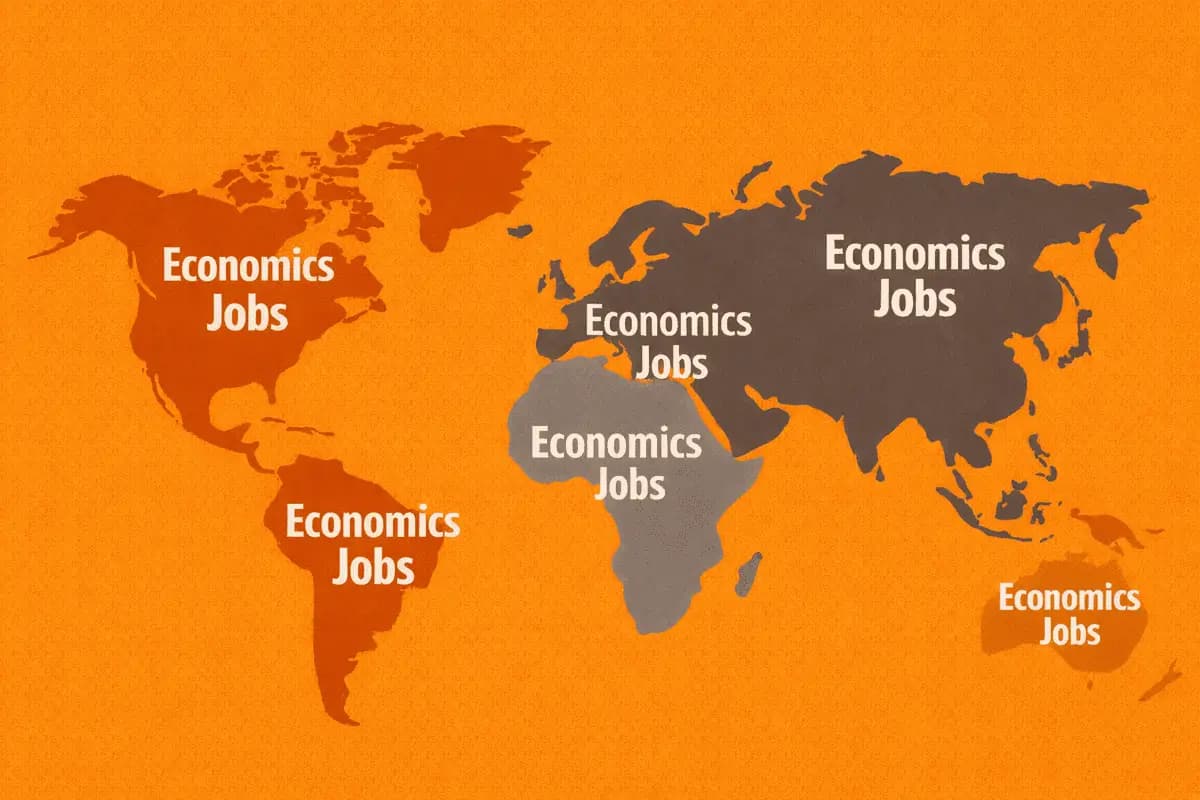
Global Overview
- Economist Jobs in the Americas
- Economist Jobs in Europe
- Economist Jobs in Asia
- Economist Jobs in the Middle East
- Economist Jobs in Africa
- Economist Jobs in Oceania
The global market for economists is no longer defined by a single country or a single career path. Instead, it is shaped by a new geography of economics jobs, where opportunities cluster around specific regions, institutions, and skill ecosystems. Understanding where economist jobs are growing, stagnating, or transforming has become a strategic advantage, not just a curiosity.
In today’s labor market, economist careers are increasingly concentrated in regional hubs tied to public policy, financial markets, technology, and international institutions. Central banks, multilateral organizations, research institutes, and data-driven private firms tend to recruit where talent density, infrastructure, and institutional influence already exist. This creates strong geographic asymmetries, both in hiring volume and in compensation.
At the same time, remote work, international mobility, and the rise of data and AI-driven economic analysis are reshaping how and where economists can build careers. While location still matters, the rules are no longer static. Some regions are emerging as new centers of demand, while others face declining opportunities or increasing competition.
This article takes a continent-by-continent approach to the economics job market, analyzing where economists are hired, which sectors dominate, and how geographic trends affect career prospects. Whether you are an early-career economist, a PhD candidate, or an experienced professional considering relocation, understanding this global map is essential to making informed career decisions.
Economist Jobs in the Americas
Across the Americas, economist jobs remain highly concentrated, with the United States acting as the primary gravity center for policy, finance, and data-driven economic roles. This concentration reflects classic economic agglomeration: economists cluster where federal institutions, capital markets, advanced research infrastructure, and large datasets coexist. In the U.S. alone, the occupation counted roughly 17,600 economist jobs in 2024, a relatively small labor market with projected growth of just 1% through 2034, according to the U.S. Bureau of Labor Statistics. In such a constrained market, geography becomes decisive.
Within the United States, demand is heavily concentrated in a handful of metropolitan hubs. Washington, D.C. dominates due to federal agencies, regulators, and policy-adjacent contractors, while New York anchors finance- and market-oriented economist roles tied to asset management, banking, and risk analysis. California, particularly the Bay Area and Sacramento, reflects a different model, where economists increasingly work at the intersection of data science, experimentation, and public policy. These hubs offer not only more vacancies but also greater role diversity, which matters in a market driven largely by replacement hiring rather than net job creation, as documented in the BLS Job Outlook.
Outside the U.S., economist opportunities in the Americas are more uneven. Canada stands out as a secondary hub, with stable demand in central banking, public policy, and resource economics, supported by relatively open immigration pathways for skilled professionals. In contrast, Latin America offers fewer economist roles in absolute terms, with demand concentrated in central banks, development institutions, and multilateral organizations. Salaries and research resources remain lower on average, reinforcing northbound mobility for economists seeking global exposure. As a result, the Americas illustrate a clear pattern: a dominant U.S. core, a small number of regional satellites, and strong incentives for economists to align their job search with the continent’s most institutionally dense labor markets.
Economist Jobs in Europe
Europe’s economist job market is best understood as a network, not a single destination. Opportunities cluster around a handful of institutional and financial hubs, but the continent’s defining feature is fragmentation: different countries, languages, legal systems, and hiring calendars create multiple micro-markets that rarely behave like one unified pool. If you want a reliable anchor for this reality, follow the EU’s own data on labour markets and how employment is distributed across countries and sectors via Eurostat’s wages and labour costs overview.
The strongest gravitational force in Europe is public policy and regulation. Brussels is the continent’s policy engine, and it continuously generates demand for economists who can work on competition, industrial policy, state aid, trade, and market regulation. A concrete indicator of this demand is the European Commission’s periodic recruitment for the Chief Economist function inside DG Competition. For example, the Commission has recently run processes to build lists and fill roles inside the Chief Economist’s team, explicitly targeted at applied economists and econometricians, as shown in official calls like COM/TA/COMP/25 (DG COMP Chief Economist’s team).
If Brussels is the regulatory hub, Frankfurt is the macro and financial stability hub. The European Central Bank is one of the largest single employers in the European monetary ecosystem, and it supports a deep internal labour market for economists across monetary policy, banking supervision, market operations, and research. The scale is visible even in headline staffing figures. In 2024, the ECB reported an average of 4,297 employees (FTE), illustrating the size of the institution behind Europe’s monetary decision-making pipeline, according to the ECB Annual Report 2024.
The ECB’s presence matters for job seekers because it creates both direct and indirect demand. Direct demand comes from economist and analyst hiring inside the ECB, including research economist opportunities and structured programmes. Indirect demand comes from the ecosystem: national central banks, supervisory authorities, and private institutions that recruit similar profiles and often value ECB experience as a signal. This “credential economy” is a European constant: a small number of institutions act as career accelerators. You can see how the ECB frames research pathways and entry points on its research opportunities page.
London remains a major economist hub, but its logic is different from Brussels and Frankfurt. It is powered by capital markets, asset management, and high-frequency decision cycles, which translates into demand for macro strategists, market economists, risk economists, and economists embedded in pricing, lending, and forecasting teams. Even in public institutions, London’s ecosystem is shaped by finance-adjacent research and policy work. The Bank of England’s own description of its research function highlights work spanning monetary, regulatory, and financial stability questions, reinforcing why London remains a magnet for research-oriented economists through Bank of England research careers.
Europe also has powerful secondary hubs that can be strategic choices for candidates who want strong institutions with less “megacity congestion.” Paris combines national policy institutions with world-class academic clusters. Berlin concentrates competition, industrial, and climate policy work. Zurich and Geneva benefit from Switzerland’s role in banking and international organizations, while Amsterdam, Stockholm, and Copenhagen often offer compact markets with high analytical intensity. The reason these hubs matter is that Europe’s labour costs and earnings differ sharply by country, shaping both where employers expand and where talent chooses to live, a pattern clearly documented in Eurostat wage and labour cost comparisons.
This wage dispersion is not a footnote. It is one of the strongest forces behind Europe’s internal mobility, especially for early-career economists. Eurostat reports that average hourly labour costs range widely across the EU and that net annual earnings vary dramatically between lower-wage and higher-wage member states. For economists, that gap often translates into an incentive to move toward higher-paying hubs where research budgets, data access, and career ladders are deeper. These cross-country gaps also affect employer behaviour: institutions in higher-cost countries often recruit more selectively but offer clearer long-run progression, as illustrated in Eurostat’s documented wage ranges.
Europe’s other defining feature is the coordinated research job market for PhD economists. A large share of academic and research roles follow a structured calendar, and many European institutions coordinate interviews and flyouts through the European Job Market for Economists. This matters even outside academia because central banks, research institutes, and policy teams often recruit research-track economists using similar timing.
For candidates, the strategic lesson is simple: Europe rewards institutional literacy. The same “economist” title can mean very different work depending on whether you are targeting a Commission unit in Brussels, a central bank research team in Frankfurt, or a markets role in London. Your success depends on matching your profile to the hub’s dominant demand: policy design and impact assessment in Brussels, macro modeling and stability analysis in Frankfurt, market and risk narratives in London. If you want a tangible signal of what European institutions explicitly recruit for, review the role design and entry criteria embedded in official calls such as the DG COMP Chief Economist team recruitment notice.
In practice, Europe is not “one market.” It is a set of connected hubs where mobility, specialization, and timing matter as much as credentials. Candidates who treat the continent as a single job board often waste cycles applying to roles that require local language, national legal knowledge, or specific institutional experience. Candidates who treat Europe as a map of ecosystems move faster: they target the right hubs, align their skills to local demand, and plan around the coordinated hiring calendar.
Economist Jobs in Asia
In Asia, the new geography of economist jobs is being redrawn by two simultaneous dynamics: the rise of high-capacity policy states and the acceleration of tech-integrated economic analysis. The result is a continent where economist roles cluster around a small number of “command centers” that combine government influence, capital markets, and advanced data ecosystems. Unlike Europe’s multi-institution corridor model, Asia’s hubs tend to be sharper and more specialized: finance and regulation in Singapore and Hong Kong, macro and industrial strategy in Beijing and Shanghai, innovation and corporate analytics in Bangalore, and institutional policy work anchored by major multilaterals.
A defining hub is Singapore, which has evolved into a regional headquarters city for global banks, asset managers, consultancies, and policy-adjacent organizations. Economist roles here often sit at the intersection of markets and regulation: macro strategy, inflation and growth monitoring, financial stability, and cross-border capital flow analysis. The city’s pull is reinforced by regional initiatives in payments modernization, digital assets, and cybersecurity, which expands demand for economists who can work with data science teams and understand modern financial infrastructure. This is part of a broader global trend where employers place increasing weight on AI and big data capabilities and analytical thinking, as summarized in the World Economic Forum Future of Jobs Report 2025 digest.
Hong Kong remains a major labor market for financial economists, particularly those focused on China-linked markets, risk, and asset pricing. Meanwhile, Beijing and Shanghai function as policy and corporate strategy hubs where economists work on industrial policy, trade exposure, productivity, demographic change, and increasingly on AI-enabled forecasting inside large firms and research institutions. In these markets, employers often prefer economists who can translate empirical findings into strategy, not just publishable research. The continent’s scale also creates demand for economists who can work across multiple data regimes, including administrative records, platform data, and market microstructure datasets.
A second major anchor is the development and public investment ecosystem. Manila stands out because it hosts the Asian Development Bank, which acts as a regional pipeline for economists working on infrastructure, public finance, climate adaptation, and human capital. Roles in this ecosystem frequently require a blend of applied econometrics, project evaluation, and institutional understanding of how policy and financing interact. The ADB’s mandate and operational scope illustrate why Manila remains a durable hub for development economics jobs in Asia, as described on the Asian Development Bank overview page.
The fastest-growing trend across Asia is the expansion of economist roles tied to digital money, payment systems, and financial infrastructure modernization. Economists increasingly work alongside engineers and cybersecurity specialists on questions like market design, incentives, adoption, resilience, and systemic risk. This is one reason central banks and regulators in Asia have become unusually active in innovation initiatives. A visible marker of this shift is the growth of international central bank experimentation capacity through initiatives like the BIS Innovation Hub, which has supported projects across Asia focused on next-generation financial systems and data-driven policy tools.
For job seekers, the practical implication is clear. Asia rewards economists who pair strong fundamentals with “adjacent power skills”: data engineering literacy, AI-aware empirical workflows, regulatory intuition, and the ability to communicate under uncertainty. The best opportunities concentrate in a limited set of cities, but they are diverse in content. Some hubs will favor financial economics and risk, others will favor industrial strategy and public policy, and others will favor development and climate finance. Targeting the right Asian hub is less about geography alone and more about aligning your specialization with the dominant institutional demand of that city.
Economist Jobs in the Middle East
In the Middle East, the geography of economist jobs is shifting quickly as governments push economic diversification, expand sovereign investment strategies, and professionalize policy institutions. Economist roles increasingly cluster in a small set of regional command centers where public finance, energy transition planning, and large-scale investment decisions are made. The largest hiring engines are typically tied to ministries of economy and finance, central banks, sovereign wealth funds, and regulatory authorities, which creates a market that is highly institution-driven and often faster-moving than traditional public-sector hiring elsewhere.
The leading hubs are the Gulf, particularly Riyadh and Abu Dhabi, where national transformation agendas and mega-investment programs generate demand for economists in industrial policy, labor market strategy, cost-benefit analysis, and macro monitoring. Dubai plays a complementary role as a regional business and finance hub, with more private-sector economist roles in banking, consulting, and market intelligence. At the same time, cities like Doha have strengthened their research and policy footprint through investment in think tanks and university-linked institutes. Across these hubs, economist hiring is increasingly tied to the ability to evaluate programs at scale, model long-run growth impacts, and translate evidence into decisions for senior leadership.
A major new trend is the intersection of economics with energy transition and climate finance. As countries invest in renewable capacity, hydrogen strategies, grid infrastructure, and diversification away from oil revenues, demand rises for economists who can quantify transition pathways, assess fiscal sustainability, and value risk under uncertainty. Many of these roles sit inside public institutions but operate with quasi-private performance expectations. Another fast-growing lane is data-driven policy. Governments are building national data platforms and analytics units, which increases demand for economists who can work with large administrative datasets and communicate findings to non-technical stakeholders.
For job seekers, the Middle East offers a distinctive mix: high-impact projects, rapid institutional build-out, and strong compensation in select hubs, alongside stricter requirements around clearance, cultural fit, and sector specialization. The most competitive candidates typically combine rigorous quantitative skills with public policy credibility and the ability to operate in high-stakes environments where timelines are compressed and expectations are high.
Economist Jobs in Africa
In Africa, the “new geography” of economist jobs is being reshaped by three forces: stronger regional institutions, faster adoption of data-driven policy tools, and rising demand for economists who can work at the intersection of development finance, public policy, and climate resilience. Unlike North America or Europe, economist roles are less concentrated in a single mega-hub. Instead, opportunities cluster around a handful of cities that combine political influence, donor ecosystems, and research capacity.
At the top of the map sits Nairobi, widely viewed as East Africa’s policy and development capital. It hosts a dense concentration of multilateral agencies, global NGOs, research organizations, and evaluation firms, which drives demand for economists in impact measurement, program design, and applied research. Close behind, Addis Ababa plays a unique role through the African Union and associated policy ecosystem, creating demand for economists in regional integration, trade, and public finance. In West Africa, Abidjan has strengthened as a hub due to the presence of the African Development Bank, which operates one of the continent’s most influential economist pipelines. The Bank’s institutional mandate and recruitment footprint are detailed on the African Development Bank overview.
A second trend is the rise of central banks and financial supervision as employers of economists. As inflation management, exchange-rate stability, and financial sector resilience remain priorities, central banks across Africa have expanded research, forecasting, and stress-testing functions. This has created growing demand for economists with skills in macro modeling, financial risk, and data infrastructure, often in capitals such as Accra, Johannesburg, Casablanca, and Cairo. The broader policy shift toward evidence-based decision-making is reinforced by global employer trends highlighting AI and big data as fast-growing skill areas in analytical roles, as summarized in the World Economic Forum Future of Jobs Report 2025.
Finally, climate and energy economics is becoming a defining growth lane for Africa-based economist roles. Climate finance, adaptation investment, energy transition planning, and resilience metrics are increasingly embedded in the work of DFIs, ministries, and multilaterals. For job seekers, the implication is clear: Africa’s leading hubs reward economists who combine strong quantitative skills with sector expertise and the ability to operate across institutions. As the continent’s policy and finance ecosystem matures, the “best” location is often the city that sits closest to decision-making and funding flows, which is why hubs connected to development finance and regional policy will continue to lead.
Economist Jobs in Oceania
In Oceania, the geography of economist jobs is shaped by a small number of highly developed labor markets where public policy, research, and resource-based economics intersect. Unlike larger continents, economist demand in Oceania is concentrated almost entirely in Australia and New Zealand, with limited opportunities elsewhere. This concentration reflects institutional density rather than population size. Central banks, treasury departments, competition authorities, and leading universities play an outsized role in hiring economists, making geography a decisive factor for career planning.
Australia is the dominant hub. According to the Australian Bureau of Statistics, economists and related analytical professionals are heavily concentrated in major metropolitan areas, particularly Sydney, Melbourne, and Canberra. Canberra stands out as a policy-intensive market, driven by federal departments, regulatory agencies, and public research institutions. Sydney and Melbourne host a different mix, with stronger demand from finance, consulting, and applied research roles tied to banking, infrastructure, and housing markets. In practice, this creates two parallel pipelines: a public-sector and policy track centered in Canberra, and a market-oriented track concentrated in the private sector of major cities.
New Zealand represents a smaller but highly specialized economist labor market. Demand is centered around Wellington and Auckland, with hiring dominated by the Treasury, the Reserve Bank, and a narrow set of research institutions. The Reserve Bank of New Zealand explicitly emphasizes analytical rigor, policy communication, and applied research in its economist roles, which limits volume but raises entry standards. As a result, competition is intense and career progression tends to be linear, favoring candidates who commit early to policy economics and public service rather than lateral movement across sectors.
A defining feature of Oceania is the importance of resource and environmental economics. Both Australia and New Zealand allocate significant analytical capacity to energy markets, climate policy, agriculture, and natural resource management. This creates niche but durable demand for economists with sector-specific expertise, particularly those able to combine quantitative modeling with regulatory and policy insight. International organizations and academic research confirm that climate transition and environmental policy remain structural drivers of economist employment in advanced economies, as highlighted by the OECD’s work on skills for the green transition.
From a compensation perspective, Oceania offers relatively high wages by global standards, especially in Australia, but with less dispersion than in North America. Public-sector pay bands compress salaries at senior levels, while private-sector roles remain fewer and more selective. This reinforces a key strategic reality: economist careers in Oceania reward institutional alignment more than opportunistic job switching. Geographic mobility within the region matters less than alignment with the dominant employers and policy frameworks.
Overall, the economist job market in Oceania is best understood as small, stable, and institution-driven. Opportunities are limited in number but relatively resilient, especially for economists targeting public policy, central banking, and resource-related fields. For candidates willing to specialize and commit to these ecosystems, Oceania offers a clear and predictable career structure. For those seeking rapid growth or broad sectoral mobility, however, its geographic constraints remain a defining limitation.
Your Next Move in the Global Economics Job Market
The geography of economist jobs is no longer a background variable. It is one of the most powerful drivers of career outcomes. Across continents, we see the same pattern repeat: economist roles concentrate where policy decisions are made, capital is allocated, data is abundant, and economic uncertainty demands rigorous analysis.
For job seekers, this means that success increasingly depends on aligning three elements: location, skill set, and institutional demand. Whether you are targeting central banks in Europe, data-driven roles in North America, development economics positions in Africa, or fast-growing policy and research hubs in Asia-Pacific, understanding regional dynamics helps you compete where the odds are highest.
Rather than searching blindly across hundreds of postings, economists who take a geographic and strategic approach can focus on the regions and sectors that match their profile. This is where specialized platforms matter. Econ-Jobs.com is designed specifically for economists, offering curated listings, geographic filters, and insight into the institutions that actually hire economists worldwide.
If you are serious about building or advancing a career in economics, the next step is simple. Explore current economist job opportunities by region, track hiring trends, and position yourself where demand is strongest. Start your search on Econ-Jobs.com and turn geographic insight into career momentum.