In the competitive landscape of economist careers, technical proficiency is often viewed as the primary currency. PhD candidates and junior analysts spend years mastering econometrics, refining code in Python or R, and ensuring their models are robust against scrutiny.
However, as professionals ascend the career ladder, a distinct bottleneck emerges. The skills that secure an entry-level position, rigorous data cleaning, statistical modeling, and literature review, are not the same skills that secure a promotion to Chief Economist or Head of Policy.
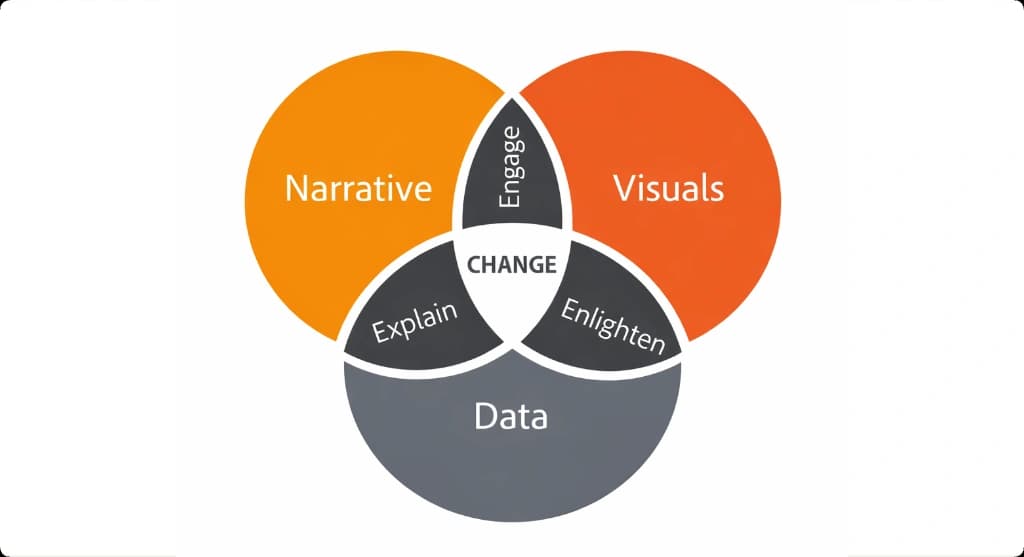
The defining differentiator at the senior level is not the complexity of the math, but the clarity of the message. Data storytelling has evolved from a corporate buzzword into a critical competency for economists working in central banks, tech firms, and international organizations. It is the ability to translate complex quantitative findings into compelling narratives that drive decision-making.
The Gap Between Output and Outcome
A common frustration among early-career economists is the perceived lack of appreciation for their technical rigor. A junior economist might spend weeks perfecting a structural model, only to have the findings glossed over in a boardroom meeting.
This disconnect occurs because stakeholders, whether they are politicians, CEOs, or the general public, do not consume economic analysis the way academics do.
They are not looking for coefficients; they are looking for confidence.
For a senior economist, the goal shifts from production to persuasion. The value of an economic model is realized only when it is understood and acted upon. According to recent insights on the labor market, the demand for social skills and communication has grown significantly faster than the demand for purely technical skills in high-wage occupations. This trend is visible in job descriptions for leadership roles at institutions like the International Monetary Fund (IMF) and the World Bank, where “strategic communication” is frequently listed alongside macroeconomic expertise.
Defining Economic Storytelling
Storytelling with data does not mean dumbing down the science or cherry-picking results to fit a narrative. In the context of professional economics, it means structuring information to align with the audience’s cognitive hierarchy. A junior analyst presents the process: the data sources, the methodology, the robustness checks, and finally the results. A Chief Economist flips this structure.
Effective economic storytelling begins with the conclusion, the “so what?” It provides the context of the problem, introduces the complication (the economic shock, the policy gap, or the market inefficiency), and offers a resolution supported by data. This narrative arc transforms abstract statistics into a tangible reality. When an economist at a tech giant like Amazon or Uber presents to the C-suite, they are not just reporting on elasticity of demand; they are telling a story about consumer behavior and future revenue.
Visualizing for Insight, Not Just Aesthetics
A critical component of this soft skill is visualization. In academia, charts are often designed to be read by peers who are willing to spend minutes deciphering a single figure. In the private and public sectors, a chart must be understood in seconds. Data visualization for decision-makers requires stripping away “chart junk”, unnecessary gridlines, 3D effects, and redundant legends, to focus the eye on the trend that matters.
Tools are secondary to design thinking. Whether an economist uses Stata, Tableau, or ggplot2, the principle remains the same: the visualization should serve the narrative. Leading management insights from sources like the Harvard Business Review emphasize that the most effective data presentations use visual cues to guide the audience’s attention directly to the insight, preventing them from getting lost in the noise. For an economist, this might mean highlighting a specific recession period on a time series or annotating a scatter plot to identify outliers, rather than letting the software dictate the default output.
Tailoring the Narrative to the Audience
The most successful economic consultants and policy advisors possess high emotional intelligence regarding their audience. They recognize that different stakeholders have different risk appetites and time horizons. A presentation on inflation dynamics requires a completely different narrative structure depending on who is in the room.
When briefing policymakers, the narrative must focus on public welfare, trade-offs, and political feasibility. The data must support a specific policy intervention. Conversely, when advising an investment committee, the narrative must pivot to risk-adjusted returns and market timing. The underlying econometric model might be identical, but the story told around it changes entirely. Failure to adapt the narrative is a primary reason why talented researchers stall in mid-level economist jobs.
Developing the Skill Set
Bridging the gap between technical execution and strategic influence requires deliberate practice. Economists looking to advance should focus on writing executive summaries before they write technical appendices. This forces the prioritization of the “headline” finding. Additionally, observing how senior leaders handle Q&A sessions can provide a blueprint for high-level communication. They rarely answer with a formula; they answer with a synthesis of the evidence.
As the market for economic data scientists becomes more saturated, soft skills will continue to serve as the key differentiator. The World Economic Forum’s Future of Jobs Report consistently highlights analytical thinking and creative thinking as top skills, but influence and leadership are rapidly climbing the list. For the modern economist, the ability to calculate the number is non-negotiable, but the ability to tell the story of that number is what leads to the corner office.