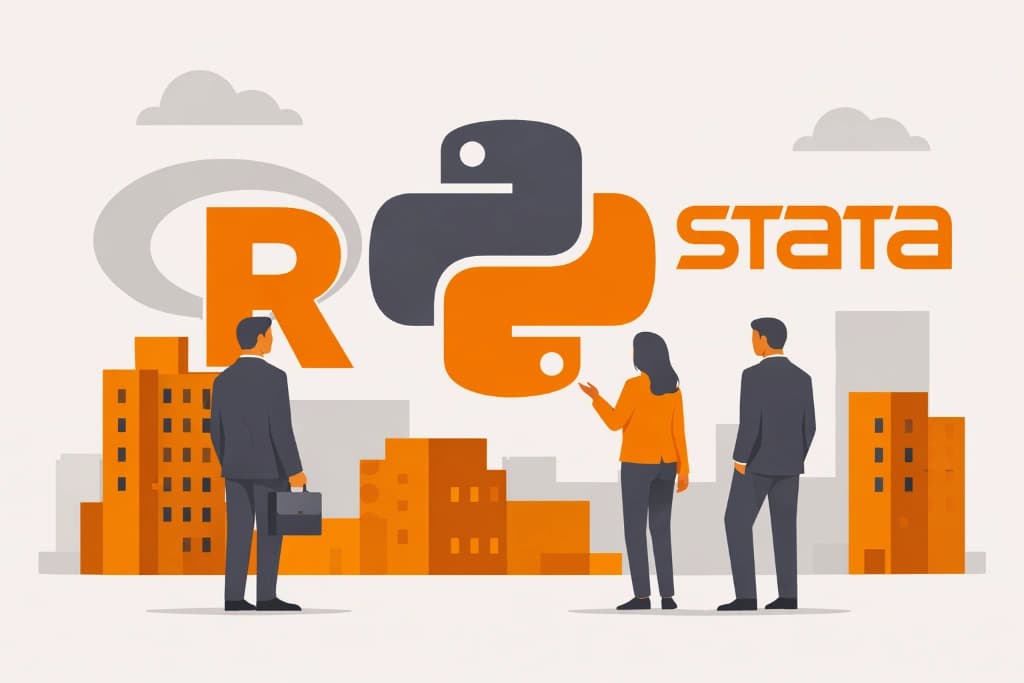
The debate over which statistical software is superior, Python, R, or Stata, has long divided the economics profession.
For years, the answer depended almost entirely on your specific subfield. Macroeconomists and financial modelers leaned toward MATLAB or Python; microeconomists and policy researchers were fiercely loyal to Stata; and statisticians or data visualization specialists preferred R.
However, as we move through 2026, the labor market for economists is undergoing a structural shift. The convergence of traditional econometrics with data science and machine learning has fundamentally altered hiring requirements. For modern economists, the question is no longer just about preference, but about employability and salary potential.
Table of Contents
“Analyzing the latest job market data reveals that the ‘one-tool’ economist is becoming an endangered species.”
By examining data from Lightcast, O*NET, and major industry reports, we can see exactly how the market values these three distinct tools in the current hiring cycle.
1. The 2026 Market Share: A Data-Driven Overview
To understand the current hierarchy of technical skills, we must look at the aggregate demand in job postings. According to data integrated into O*NET OnLine for Social Science Research Assistants and Economists, the technological landscape has widened significantly.
While traditional tools remain present, open-source languages are capturing a growing share of the “required skills” section in job descriptions. This trend is corroborated by Lightcast’s analysis of millions of job postings, which indicates two key trends:
- Stata remains a staple in academic research.
- Python has surged to become the dominant language for roles that interface with the private sector or involve large-scale data processing.
The rise of Python in economist job postings is not accidental. It correlates directly with the integration of big data into economic analysis. Employers are no longer just asking economists to run regressions on clean, rectangular datasets. They are asking them to:
- Scrape web data.
- Process unstructured text.
- Deploy predictive models into production environments.
This shift has favored Python due to its general-purpose nature. Recent job posting volumes on major aggregators like Indeed reflect this reality: searches for “Python economics jobs” now frequently yield results in fintech, tech policy, and litigation consulting—sectors that offer some of the highest compensation packages for economists.
2. Stata: The Persistent Standard in Academia and Policy
Despite the meteoric rise of Python, it would be a career error to dismiss Stata as obsolete. For economists targeting roles in academia, central banks, and international organizations, Stata remains the lingua franca of applied microeconomics.
A review of the American Economic Association (AEA) Job Openings for Economists (JOE) demonstrates that Stata proficiency is still explicitly required or preferred in a vast majority of tenure-track and policy research positions. The software’s dominance in panel data analysis and its entrenched status in top-tier journal replication packages ensure its continued relevance.
Qualitative evidence from institutions like the Harvard Growth Lab and recent Research Assistant (RA) postings from Columbia Economics supports this view. Academic pipelines prioritize candidates who can immediately replicate existing literature, much of which is written in Stata do-files. Furthermore, the ease of use for standard econometric tasks—such as fixed-effects models or complex survey weighting—keeps Stata efficient for pure research roles.
The verdict: While Stata is necessary for these sectors, it is increasingly becoming insufficient on its own. The modern policy economist is now often expected to use Stata for the final econometric estimation while utilizing R or Python for the initial data wrangling and visualization.
3. R: The Bridge Between Statistics and Economics
Sitting comfortably between the rigid specificity of Stata and the broad utility of Python is R.
Data analysis jobs in the public sector and non-profits often favor R for its unparalleled libraries in statistical modeling and data visualization, such as ggplot2 and the Tidyverse. Comparative analyses on R-Bloggers highlight that while Python leads in general-purpose coding, R retains a distinct edge in specialized statistical modeling and academic data science.
For economists, R is frequently the tool of choice for:
- Spatial analysis (GIS).
- Time-series forecasting, where pre-built packages offer robust solutions.
- Data Journalism, where communicating insights through high-quality visual outputs is critical.
While Python has caught up significantly in statistical capabilities, R maintains a loyal user base among statisticians and econometricians who find its syntax more intuitive for vector operations and matrix algebra. It serves as a critical hedge for economists: learning R opens doors to data science roles that Stata cannot reach, while retaining a “statistical first” philosophy that aligns closer to traditional economics than Python’s “engineering first” approach.
4. The “Polyglot” Premium and Private Sector Demands
The most significant insight from the 2026 data is the emergence of the “polyglot” requirement. Historical analysis of job postings suggests a decline in single-skill demand. Today, a significant percentage of high-value postings list combinations like “Stata/R” or “Python and econometrics.”
“Employer demand is shifting toward polyglot candidates who can bridge the gap between rigorous causal inference and scalable data engineering.”
This is particularly true in the private sector. Tech comparisons by Bacancy Technology emphasize that while R excels in exploration, Python’s architecture is preferred for scalability and production, explaining why professionals who combine domain expertise (economics) with modern coding stacks command a significant wage premium.
In consulting and tech, the economist career path has merged with data science. Here, Python is non-negotiable because it integrates with the broader tech stack. An economist at a tech firm might need to write a causal inference model that feeds directly into a product recommendation engine. Stata cannot do this easily; Python can.
Consequently, economists looking to pivot into the corporate world must treat Python not as an optional “add-on” but as a core literacy. The 2025 Developer Survey from Stack Overflow reinforces this, showing Python’s overwhelming popularity and community support, which translates to easier troubleshooting and faster learning for economists making the switch.
5. Future-Proofing Your Skills for 2030
Looking ahead, the influence of Artificial Intelligence and Large Language Models (LLMs) is reshaping how economists code. Lightcast’s 2026 predictions suggest that AI-related skill demand is accelerating.
Python is the native language of AI. Economists who use Python are better positioned to leverage API-based data collection, automate literature reviews, and utilize machine learning libraries like Scikit-Learn or TensorFlow to analyze high-dimensional data. While Stata has introduced Python integration to stay relevant, the native Python user has a distinct advantage in adapting to AI-driven workflows.
The Strategy for the Modern Economist:
- Tenure-Track / Federal Reserve: Deep Stata expertise is required, but adding R or Python will make you a more efficient researcher.
- Private Sector / Tech / Litigation: Python is your primary asset. Stata is merely a background bonus.
Ultimately, the market pays for the ability to solve problems. In 2026, the economists who can solve the widest range of problems are those who have expanded their toolkit beyond the traditional boundaries of the discipline.